Three Brothers
Mariners' Museum, Uncurated Search Results
Type: Pungy
Year:
Builder:
Location:
These records are found in the online catalog of The Mariners’ Museum and Park in Newport News, Virginia. Uncurated search results are presented to give researchers and interested readers an idea of whether the museum’s archives contain information about this vessel and whether it may be worthwhile to visit the museum’s catalog search page for further investigation. Uncurated results may be inaccurate or incomplete.
Search mode: Exact Name. Search phrase(s): "Three Brothers". Results returned: 28. Results displayed in this table: 28.
Use these buttons to send uncurated search results to your own app or text document for further research. First, check the box for any row, or click "Select All" then uncheck any rows. Then click "Show Selections". You can then copy your selections from the text box and past them into your app.
| Fetch? | Row ID | Media | Date | Vessel | Place | Related Places | Inscription/Marks | Subject | Notes | Archive Number |
|---|---|---|---|---|---|---|---|---|---|---|
| 1 | No image URL. | VESSEL NAME: THREE BROTHERS ALL SHIP'S NAMES: (1) VANDERBILT (SIDE-WHEEL BRIG: 1856-1861;1867-1873); (2) USS VANDERBILT (CRUISER: 1862-1866); (3) THREE BROTHERS (SHIP: 1873-1899). VESSEL TYPE: PADDLE WHEEL STEAMER VESSEL HISTORY: The THREE BROTHERS was converted from the paddle wheel steam VANDERBILT in 1873. The steamer was purchased from the government by George Howes & Co., who converted her into a full rigged sailing ship. She made a name for herself as a fast sailer and remained active until 1885 at which time she was sold for duty as a coal hulk at Gilbraltar. Finally broken up in the 20's, | CL744 | |||||||
| 2 | 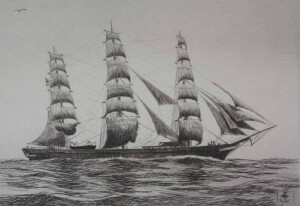 | NOTES: Charles J. A. Wilson was born in 1880 in Glasgow, Scotland. He came to America as an infant and in his teens moved to Newton, Massachusetts. Wilson was a prolific, self-taught, marine artist who gained much of his experience from working in the Boston shipyards. He worked as an artist for Bethlehem Shipbuilding in East Boston, etching their ships from blueprints. During the World War I, Wilson spent two years in France. After the war he was commissioned to paint and etch American ships and marine views. During World War II, Wilson worked in Boston as an official Coast Guard artist. He was a member of the Boston Society of Printmakers, and exhibited with Pennsylvania Academy of the Fine Arts, Society of American Etchers and the Currier Gallery. VESSEL INFORMATION- VESSEL NAME: THREE BROTHERS VESSEL TYPE: FULL RIGGED SHIP Alternate vessel names: (1) VANDERBILT (STEAMSHIP: 1855-1873); THREE BROTHERS (SHIP: 1873-1929). SHIPBUILDER: JEREMIAH SIMONSON SHIPBUILDER LOCATION: NEW YORK, GREENPOINT VESSEL DATES: 1855-1929 SHIPOWNER: NORTH AMERICAN MAIL STEAMSHIP CO. VESSEL HISTORY: The ship served as a Civil War cruiser and as a coal hulk during her existence. The ship was rebuilt by Coombs & Taylor of San Francisco. Later owners include George Howes & Co., John Williams of Liverpool, Henderson Brothers, London Coal Co. | CL15971 | |||||||
| 3 | No image URL. | Three Brothers (1856) | P0001.011/01-2955 | |||||||
| 4 | 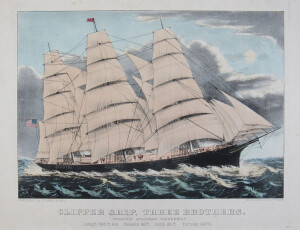 | VESSEL INFORMATION - VESSEL NAME: THREE BROTHERS ALL SHIP'S NAMES: (1) VANDERBILT SIDE-WHEEL BRIG: 1856-1861; 1867-1873); (2) USS VANDERBILT (CRUISER: 1862-1866); (3) THREE BROTHERS (SHIP: 1873-1899). VESSEL TYPE: CLIPPER SHIP SHIP BUILDER: JEREMIAH SIMONSEN BUILDER LOCATION: GREENPOINT, LONG ISLAND, NEW YORK SHIP OWNER: COMMODORE VANDERBILT | CL8562 | |||||||
| 5 | 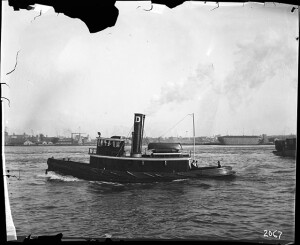 | 4/29/1896 | Three Brothers (Steamboat : 1892). | Three Brothers - (tug); 2067 | Steamboats–United States.; Tugboats–United States. | Shows a port side view of a tugboat making way. Stanton's notebooks contain the following information about this item: "Apl 29, 96" | MS0094/01-#2067 | |||
| 6 | VESSEL INFORMATION - VESSEL NAME: THREE BROTHERS VESSEL TYPE: AMERICAN CLIPPER SHIP VESSEL BUILT: 1855 SHIPBUILDER: JEREMIAH SIMONSON Alternate vessel names: (1)VANDERBILT (STEAMSHIP: 1855-1873); (2) THREE BROTHERS (SHIP: 1873-1929). | CL6186 | ||||||||
| 7 | 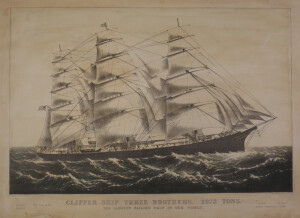 | NOTES: The Mariners' Museum possesses the original lithographic stone(Q 129). LABEL COPY: Built as the wooden steamship VANDERBILT in 1855 by Jeremiah Simonsen, Greenpoint, Long Island, and used in transatlantic trade for the North American Mail Steamship Line. Mr. Vanderbilt gave the vessel to the U.S. Government during the Civil War and she was used as a "cruiser". She was laid up at Mare Island, California from 1866 until 1873 when sold to George Howes & Co. The Howes Brothers had her converted to the full rigged ship THREE BROTHERS, by Coombs & Taylor, San Francisco. She was the largest sailing ship of her day, and very fast. In 1880 she was sold to John Williams, Liverpool, and sailed under the British flag. After several more voyages to San Francisco she became a coal hulk at Gibraltar. Finally in 1929 she was sold to Spanish firewood merchants and broken up. ADDITIONAL INFORMATION: Peters, Fred J., "Clipper Ship Prints by Currier & Ives", p. 54-55. VESSEL INFORMATION: VESSEL NAME: THREE BROTHERS VESSEL TYPE: clipper ship SERVICE DATES: 1855-1929 SHIP BUILDERS: Jeremiah Simonson BUILDER LOCATION: New York SHIP OWNER: The Commodore Vanderbilt Service VESSEL HISTORY: She was a steamship originally named the VANDERBILT. Sold to the U.S. Government in 1861 and used in the Civil War. After the War she was purchased by California merchants, three brothers, partners in the shipping business. ALL SHIP NAMES: (1)VANDERBILT (2)THREE BROTHERS | CL17923 | |||||||
| 8 | 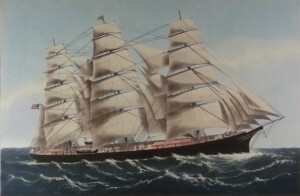 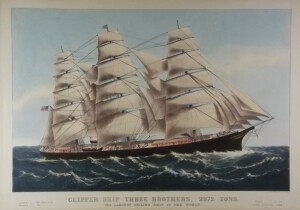 | NOTES: This piece was purchased with five other prints and the original catalog sheet indicates that this was a restrike by Max Williams; however, except for size, this piece does not stylistically match the other pieces attributed to Max Williams. NOTES: The Mariners' Museum possesses the original lithographic stone(Q 129). LABEL COPY: Built as the wooden steamship VANDERBILT in 1855 by Jeremiah Simonsen, Greenpoint, Long Island, and used in transatlantic trade for the North American Mail Steamship Line. Mr. Vanderbilt gave the vessel to the U.S. Government during the Civil War and she was used as a "cruiser". She was laid up at Mare Island, California from 1866 until 1873 when sold to George Howes & Co. The Howes Brothers had her converted to the full rigged ship THREE BROTHERS, by Coombs & Taylor, San Francisco. She was the largest sailing ship of her day, and very fast. In 1880 she was sold to John Williams, Liverpool, and sailed under the British flag. After several more voyages to San Francisco she became a coal hulk at Gibraltar. Finally in 1929 she was sold to Spanish firewood merchants and broken up. ADDITIONAL INFORMATION: Peters, Fred J., "Clipper Ship Prints by Currier & Ives", p. 54-55. VESSEL INFORMATION: VESSEL NAME: THREE BROTHERS VESSEL TYPE: clipper ship SERVICE DATES: 1855-1929 SHIP BUILDERS: Jeremiah Simonson BUILDER LOCATION: New York SHIP OWNER: The Commodore Vanderbilt Service VESSEL HISTORY: She was a steamship originally named the VANDERBILT. Sold to the U.S. Government in 1861 and used in the Civil War. After the War she was purchased by California merchants, three brothers, partners in the shipping business. ALL SHIP NAMES: (1) VANDERBILT (STEAMSHIP: 1855-1873); (2) THREE BROTHERS (SHIP: 1873-1929). | CL30085 | |||||||
| 9 | No image URL. | Nantucket (Mass.)–History | Publications (Nantucket, Mass. Whaling Museums) | Map on lining-paper. | LB10235 | |||||
| 10 | 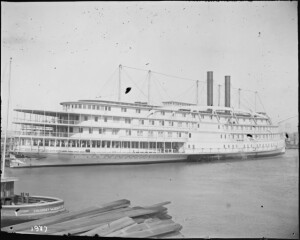 | 3/19/1896 | Adirondack (Side wheel steamer : 1896).; Three Brothers (Steamboat : 1892). | Adirondack; 1986 | Steamboats–United States.; Paddle steamers–United States.; Tugboats–United States. | Shows a starboard side view of a huge passenger boat docked at a wharf. The shot is made looking across the bow of a tugboat. This shot is similar to 1986. Stanton's notebooks contain the following information about this item: "Mar 19, 1896" | MS0094/01-#1987 | |||
| 11 | 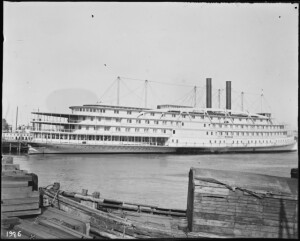 | 3/19/1896 | Adirondack (Side wheel steamer : 1896).; Three Brothers (Steamboat : 1892). | Adirondack; 1986 | Steamboats–United States.; Paddle steamers–United States.; Tugboats–United States. | Shows a starboard side view of a huge passenger boat docked at a wharf. The shot is made looking across the bow of a tugboat. Stanton's notebooks contain the following information about this item: "Mar 19, 1896" | MS0094/01-#1986 | |||
| 12 | No image URL. | Horn, Cape (Chile). | Seafaring life. | Around Cape Horn. | LB60286 | |||||
| 13 | 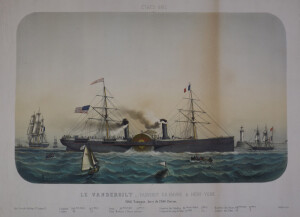 | NOTES: Louis Le Breton served from 1837 – 1840 on the ship ASTROLABE with the famous French explorer Jules Sébastien César Dumont d'Urville. Le Breton was originally the surgeon’s aide on the ship, but he became the voyage’s artist after the death of the ASTROLABE’S official artist. After his service with Dumont d’Urville, Le Breton focused his art on depictions of ships. LABEL COPY: Built as the wooden steamship VANDERBILT in 1855 by Jeremiah Simonsen, Greenpoint, Long Island, and used in transatlantic trade for the North American Mail Steamship Line. Mr. Vanderbilt gave the vessel to the U.S. Government during the Civil War and she was used as a "cruiser". She was laid up at Mare Island, California from 1866 until 1873 when sold to George Howes & Co. The Howes Brothers had her converted to the full rigged ship THREE BROTHERS, by Coombs & Taylor, San Francisco. She was the largest sailing ship of her day, and very fast. In 1880 she was sold to John Williams, Liverpool, and sailed under the British flag. After several more voyages to San Francisco she became a coal hulk at Gibraltar. Finally in 1929 she was sold to Spanish firewood merchants and broken up. ADDITIONAL INFORMATION: Peters, Fred J., "Clipper Ship Prints by Currier & Ives", p. 54-55. VESSEL INFORMATION: VESSEL NAME: THREE BROTHERS VESSEL TYPE: clipper ship SERVICE DATES: 1855-1929 SHIP BUILDERS: Jeremiah Simonson BUILDER LOCATION: New York SHIP OWNER: The Commodore Vanderbilt Service VESSEL HISTORY: She was a steamship originally named the VANDERBILT. Sold to the U.S. Government in 1861 and used in the Civil War. After the War she was purchased by California merchants, three brothers, partners in the shipping business. ALL SHIP NAMES: (1) VANDERBILT (1855-1873); (2) THREE BROTHERS (1873-1929). | CL19401 | |||||||
| 14 | No image URL. | LABEL COPY: Built as the wooden steamship VANDERBILT in 1855 by Jeremiah Simonsen, Greenpoint, Long Island, and used in transatlantic trade for the North American Mail Steamship Line. Mr. Vanderbilt gave the vessel to the U.S. Government during the Civil War and she was used as a "cruiser". She was laid up at Mare Island, California from 1866 until 1873 when sold to George Howes & Co. The Howes Brothers had her converted to the full rigged ship THREE BROTHERS, by Coombs & Taylor, San Francisco. She was the largest sailing ship of her day, and very fast. In 1880 she was sold to John Williams, Liverpool, and sailed under the British flag. After several more voyages to San Francisco she became a coal hulk at Gibraltar. Finally in 1929 she was sold to Spanish firewood merchants and broken up. ADDITIONAL INFORMATION: Peters, Fred J., "Clipper Ship Prints by Currier & Ives", p. 54-55. VESSEL INFORMATION: VESSEL NAME: THREE BROTHERS VESSEL TYPE: clipper ship SERVICE DATES: 1855-1929 SHIP BUILDERS: Jeremiah Simonson BUILDER LOCATION: New York SHIP OWNER: The Commodore Vanderbilt Service VESSEL HISTORY: She was a steamship originally named the VANDERBILT. Sold to the U.S. Government in 1861 and used in the Civil War. After the War she was purchased by California merchants, three brothers, partners in the shipping business. ALL SHIP NAMES: (1) VANDERBILT(1855-1873); (2) THREE BROTHERS (1873-1929). | CL19362 | |||||||
| 15 | 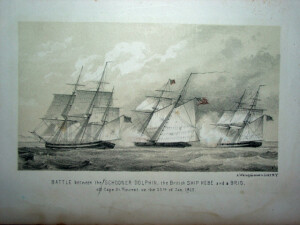 | SHORT DESCRIPTION: Black and white print showing the battle between the HMS Hebe, the 12-gun American privateer schooner Dolphin and the 10-gun brig Three Brothers off the coast of Spain. NOTES: The 12-gun American privateer schooner Dolphin was captured by Admiral John Borlase Warren's squadron on April 3, 1813 and taken into Royal Navy service. The Dolphin had carried a privateering commisson (No. 2) issued by Baltimore. Under Captain W. S. Stafford Dophin had captured a British merchant vessel on July 26, 1812 and in August the British schooners Fanny and James. Dolphin also destroyed several doggers. She captured the 10-gun John Hamilton carrying several tons of mahogany. In January/February 1813 Dolphin captured the 16-gun HMS Hebe and brig Three Brothers. Both HMS Hebe and Three Brothers were recaptured by the HMS Shannon about six days later. As a privateer Dolphin captured eleven vessels, nine of which safely reached the United States. A British cutting out expedition under Lt. James Polkinghome on the Rappahannock River captured four vessels on April 3, 1813--the 7-gun Arab, the 6-gun Racer, the 6-gun Lynx, and the 12-gun Dolphin. Dolphin resisted for two hours before surrendering. Racer, Lynx and Dolphin were taken into the Royal Navy. | CL19746 | |||||||
| 16 | INVENTORY: Steering wheel support and pin - there is one (1) component part. LABEL COPY: Steering Wheel, SS VANDERBILT, 1857 The Mariners' Museum DS 0028 (The Bard Brothers: Painting America Under Steam and Sail, February 7, 1998 ADDITIONAL INFORMATION: See "The Down Easters", by Lubbock, VM23L 93, pg. 78-85. VESSEL INFORMATION- VESSEL NAME: SS VANDERBILT VESSEL BUILT 1857 VESSEL DIMENSIONS: 311' (length), 47' (breadth), 31'9" ((depth of hold). VESSEL HISTORY: The Vanderbilt was a wooden, brig rigged, paddlewheel steamer, built at Greenpoint, Long Island, N.Y. in 1856-7 by Jeremiah Simonson to the order of the great financier Commodore Vanderbilt. In the 1850's she was considered the fastest steamship afloat. In 1873 the Vanderbilt was converted into a full rigged ship and renamed Three Brothers. As a sailing ship she was outstanding. Alternate vessel names: (1) VANDERBILT (SIDE-WHEEL BRIG: 1856-1861; 1867-1873); (2) USS VANDERBILT (CRUISER: 1862-1866); (3) THREE BROTHERS (SHIP: 1873-1899). | CL742 | ||||||||
| 17 | 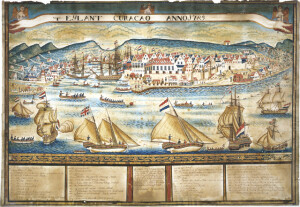 | SHORT DESCRIPTION: Tempera painting. NOTES: A rough translation of the text is: A view of the island, seen from sea directly facing the harbour. Viewd from the Three Brothers to the mountain ranges of [Brabe?] with numbers of all important fortifications, buildings, populated areas and estates, as mentioned before. Curacao Anno 1784. | CL15540 | |||||||
| 18 | 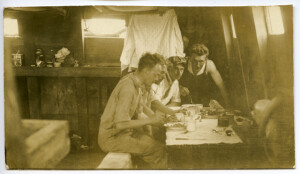 | 1913-1914 | THE COMMONWEALTH OF THE BAHAMAS | The three brothers are having a meal aboard Jules Verne. John E. Williamson was born in Liverpool, England, 1881[1] to Charles Williamson, a sea captain from Norfolk, Virginia[2]. Charles had invented a deep-sea tube, made of concentric iron rings, "which stretched like an accordion". [2]The tube was used for underwater repair and for ship salvage. In 1912 Williamson while working as a reporter made undersea photographs and motion pictures. (1881-1966) was active in motion pictures for nearly fifty years. His father was a sea captain, Charles Williamson of Norfolk, who had invented a deep-sea tube, made of a series of concentric, interlocking iron rings, which stretched like an accordion. Suspended from a specially outfitted ship, this shaft into the sea facilitated easy communication and plentiful air down to depths of up to 250 feet. When attached to a diving-bell type apparatus, the tube could be used for underwater repair and salvage work. In 1912, young Williamson, then a journalist, realized that his father's mechanism could also be used to obtain undersea photographs or even motion pictures. With a light hung from the mother ship to illuminate the sea in front of the tube, still photographs of the depths of Hampton Roads, Virginia, proved so successful that Williamson was urged to try motion pictures." 1. "Motion Pictures Under the Sea", Cleveland Moffett, The American Magazine, January 1915. Page 16. 2."With Williamson Beneath the Sea". UCLA. http://www.cinema.ucla.edu/FIAF/Journal/html52/withwill.html. | MS0175/-#018 | |||||
| 19 | No image URL. | VESSEL INFORMATION - VESSEL NAME: VANDERBILT SHIPBUILDER: JERIMIAH SIMONSON SERVICE DATES: 1856-1899 BUILDER LOCATION: NEW YORK, NEW YORK VESSEL DIMENSIONS: 311'X47'X31'9", 3,360 tons Alternate vessel names: (1)VANDERBILT (SIDE-WHEEL BRIG: 1856-1861; 1867-1873); (2) USS VANDERBILT (CRUISER: 1862-1866); (3) THREE BROTHERS (SHIP: 1873-1899). | CL6302 | |||||||
| 20 | 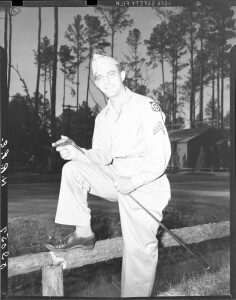 | 8/3/1944 | United States. Army. | K9056 - Cpl. Joseph J. Fortunato, 32549517, Special Service Station Athletic Department, Hqs. Co., Station Complement Bn., Camp Patrick Henry, Va. Home address, 6040 Spencer Ave., New York, New York. Pro golfer for nineteen years. Has won the Adirondack Open Championship for eight years in succession. Also has three brothers that are Golf professionals. 8-3-44 Official Photograph, U. S. Army Signal Corps, HRPE, Newport News, Va. | Amusements–Virginia–Newport News.; Golf–Virginia–Newport News.; Golfers–Virginia–Newport News. | A soldier poses with a golf club in a wooded area. In the distance are the tops of barracks-like buildings. | P0003/01-#K-9057 | |||
| 21 | 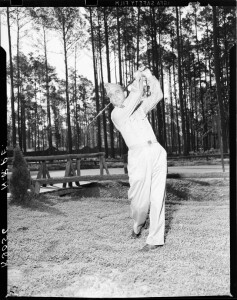 | 8/3/1944 | United States. Army. | K9056 - Cpl. Joseph J. Fortunato, 32549517, Special Service Station Athletic Department, Hqs. Co., Station Complement Bn., Camp Patrick Henry, Va. Home address, 6040 Spencer Ave., New York, New York. Pro golfer for nineteen years. Has won the Adirondack Open Championship for eight years in succession. Also has three brothers that are Golf professionals. 8-3-44 Official Photograph, U. S. Army Signal Corps, HRPE, Newport News, Va. | Amusements–Virginia–Newport News.; Golf–Virginia–Newport News.; Golfers–Virginia–Newport News. | A soldier swings a gold club in a wooded area. In the distance are the tops of barracks-like buildings. | P0003/01-#K-9056 | |||
| 22 | No image URL. | SHORT DESCRIPTION: (Morzer Bruyns, 1995) Gunter scale, made by BELCHER Brothers of New York. NOTES: According to a note in the Collection file "this "scale" was found in the attic of an old house in Maine, formerly occupied by an old sea ("Square Rigger") captain and given me by my friend Alfred W. Jansen. I have been unable to trace its origin. "Belcher Brothers" New York, as stamped on scale, have been out of business for years. It was evidently used for navigation, the workd "SINES" and "MERID" would so indicate. Mr. Johnson of John Bliss & Co. Inc., the nautical instrument makers, became interested in tracing its origin and use and we sent it to several scale makers, etc. but without success. It was evidently one of the crude instruments used in charting a ship's course in the old days of navigation. The Gunter's scale is a wooden rule, two feet long, on one side of which are marked scales of equal parts, of chords, sines, tangents, rhombs, etc., and on the other side scales of logarithms of these various parts, by means of which many problems in surveying and navigation may be solved, mechanically, by the aid of dividers alone. NOTES: The Belcher Brothers of New York city had a rule making business during the 1820's through the mid to late 1870s. There were three brothers: Thomas, William & Charles. The mark on this ruler dates the object to the 1831 to 1843 time period. REMARKS: (Morzer Bruyns, 1995) The Peabody Essex Museum has a similar instrument, by the same makers. An interesting object, in good condition, but it needs cleaning. TIME-SPACE: 1828-1864. ADDITIONAL INFORMATION: SEE M.V. BREWINGTON, THE PEABODY MUSEUM COLLECTION OF NAVIGATING INSTRUMENTS. SALEM, 1963, PP.108 & 119. SEE COLLECTION FILE. | CL14799 | |||||||
| 23 | No image URL. | Liscome Bay (Escort aircraft carrier : CVE-56).; United States. Navy–History–20th century. | World War, 1939-1945–Naval operations, American.; World War, 1939-1945–Campaigns–Kiribati.; Shipwrecks–Kiribati.; Aircraft carriers–United States. | Twenty-three minutes to eternity : __the final voyage of the escort carrier U.S.S. Liscome Bay __James L. Noles, Jr | LB91941 | |||||
| 24 | 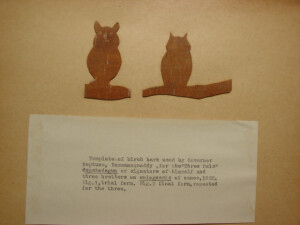 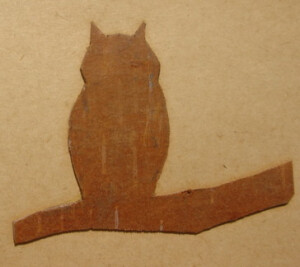 | SHORT DESCRIPTION: Bark decoration sample. Templated has the shape of an owl sitting on a branch. NOTES: The items associated with 2000.38 were produced by Edwin Tappan Adney to illustrate a manuscript on the history, development and manufacture of bark canoes in North America. The bark decoration samples and paddle samples were mounted to paper in groups. When found they were extremely dirty and water stained. The mounting papers and backing boards were extremely brittle. To help preserve the samples they were removed from their decaying mounts, photo-documented and accessioned in a way that preserved the groupings that Adney created. Whenever possible the mounts were saved. | CL29456 | |||||||
| 25 | 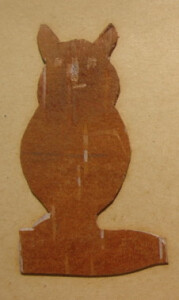 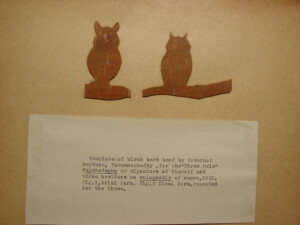 | SHORT DESCRIPTION: Bark decoration sample. Templated has the shape of an owl sitting on a branch. NOTES: The items associated with 2000.38 were produced by Edwin Tappan Adney to illustrate a manuscript on the history, development and manufacture of bark canoes in North America. The bark decoration samples and paddle samples were mounted to paper in groups. When found they were extremely dirty and water stained. The mounting papers and backing boards were extremely brittle. To help preserve the samples they were removed from their decaying mounts, photo-documented and accessioned in a way that preserved the groupings that Adney created. Whenever possible the mounts were saved. | CL29455 | |||||||
| 26 | 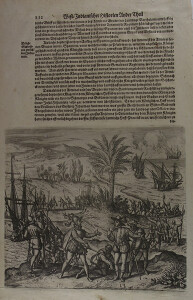 | SHORT DESCRIPTION: Page 212 from Johann Gottfried's 1655 publication 'Newe Welt Und Americanische Historien.' The image shows a scene during Christopher Columbus's third voyage to the New World (May 1498- sometime in 1500). It seems to show a discussion between Columbus and Francisco de Bobadilla, and may show Columbus being arrested as a man kneeling on the ground at Columbus's feet appears to be putting shackles around his legs while another appears to be taking Columbus’s sword. There are four ships in the background, one at the left and three at the right. Many troops carrying pole arms are in the background. At the left, it appears as though a man, possibly one of Columbus’s brother who were also arrested, is being loaded into a small boat. NOTES: The story according to thoughtco.com states that Columbus organized a third voyage to the New World in order to resupply the colony on Hispanola and continue the search for a route to the Orient. Three of Columbus’s ships headed directly for Hispanola and the other three, under Columbus, continued exploring the area. On July 31st an island was sighted, which Columbus named Trinidad. For the first two weeks of August the fleet explored the Gulf of Paria. They discovered the island of Margarita and the mouth of the Orinoco River. Columbus fell ill so the fleet sailed back to Hispaniola, which they reached on August 19, 1498. During Columbus’s two year absence the colony had suffered. Columbus had been a poor governor and the colonists were not happy to see him. They revolted and Columbus was forced to hang a few to restore order. Columbus sent to Spain for assistance and Francisco de Bobadilla arrived in Hispaniola in August 1500 with 500 men in four ships. Bobadilla found the situation bad, he and Columbus clashed, and Bobadilla arrested Columbus and his brothers. In October the three brothers were sent back to Spain in chains. NOTES: From: Newe Welt Und Americanische Historien: Inhaltende Warhafftige und vollkommene Beschreibungen Aller West-Indianischen Landschafften/ Insulen/ Königreichen und Provintzien/ Seecusten/ fliessenden [...] / ... zusam[m]en getragen/ ... Durch Johann Ludwig Gottfriedt. Mit zugehörigen Landtafeln ... und ... Kupfferstücken ... gezieret und verlegt/ Durch Mattheum Merian/ ... Franckfurt: Meriansche Erben, 1655 In the section: West Indianischer Historien Ander Theil [second part]/ Von Erfindung derselben durch underschiedliche Schiffarthen In the chapter: Die dritte schifffart herzn Christophori Columbi dess Admirals in die newe welt, Anno Christi 1498 Image on page: 212. NOTES: This engraving comes from Johann Ludwig Gottfried's abridgment of Theodor de Bry titled Newe Welt und Americanische Historien [published in 1655]. Little is known about the German publisher Johann Ludwig Gottfried (c. 1584-1633), who inherited Theodor De Bry’s (1528-1598) publishing firm. Gottfried studied theology in Heidelberg. As of 1603 he was active as deacon, afterwards as reformed priest in villages in the Electoral Palatinate's left side of the Rhine. Between 1625 and 1633 he was active in Offenbach. Owing to his talent for languages and his education in general, he became a highly esteemed assistant of Frankfurt publishers like Johann Theodor de Bry, de Bry's nephew Lucas Jennis and de Bry's son in law Matthäus Merian the Elder as of 1619. He made translations, epigrams, paraphrases and compilations for many distinguished publications. Between 1590 and 1634, de Bry and his sons issued thirteen volumes containing illustrated accounts of the expeditions of Magellan, Columbus, Vespucci, Cortes, Balboa, Raleigh, Drake, Smith, and many others. In most cases, theirs were the first images ever made of the Americas by Europeans. In 1631 Gottfried, who had worked on the volumes and inherited the de Bry family publishing firm, issued together with Matthaeus Merian (publisher, artist & engraver) a one-volume condensation "Newe Welt Vnd Americanische Historien/ Jnhaltende Warhafftige vnd volkommene Beschreibungen Aller West-Indianischen Landschafften..." that used many of the original copper plates and supplemented them with new ones of more recent voyages." The first edition of the abridgment was published by Matthaeus Merian in 1631. It was reprinted in 1655. | CL16777 | |||||||
| 27 | 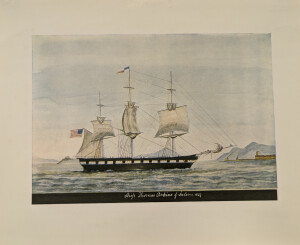 | SHORT DESCRIPTION: Colored book illustration titled 'Ship Thomas H. Perkins of Salem 1837' pulled from the book 'Old Time Ships of Salem' published by the Essex Institute in Salem, Massachusetts. NOTES: According to the introduction of 'Old Time Ships of Salem' several banks in Salem, the Asiatic National Bank of Salem and the Naumkeag Trust Company began the production of calendars with images of ships belonging to the port of Salem in 1902. The images were pulled together and other images were added to produce the book 'Old Time Ships of Salem.' The supporting text was written by Hon. Robert S. Rantoul or Mr. William O. Chapman for the original calendars and it was reprinted in 'Old Time Ships of Salem' in condensed form. The book was first published in 1917. A second edition was published in 1922. NOTES: Text supporting the book plate found on pages 68-70 of the second edition (published 1922): The ship "Thomas Perkins," of Salem, was built at Portsmouth, N. H., in 1837, for David Pingree and Emery Johnson. She was 156-9/10 feet in length, 28 and 4-1/2 tenths feet in breadth, and 20 feet deep, with two decks, a square stern, a billet head, and a capacity of 595 64-100 tons. The vessel arrived in Salem, September 1, 1837, and sailed upon her first voyage November 29, William Graves, Jr., of Newburyport, master, for Mobile and thence to Liverpool and China. She did not return to the United States until June 21, 1842, arriving in New York from Manila after one of the most remarkable and profitable voyages on record. During most of this long period of almost five years, being a neutral ship, she was engaged in distributing the cargoes of the English vessels in Chinese ports, which were then closed to the English by reason of the Opium War. The opium trade of the East India Company with China, which was worth £1,000, 000 το £1,500,000 to British India, and amounted to 30,000 chests in 1837, was stopped that year by the Chinese government, although the trade had actually been illegal since 1796. Various seizures, riots and diplomatic incidents finally led to a declaration of war by the British government in 1840. Nine-tenths of the British merchants in China were engaged in the illegal traffic when British shipping was excluded from Chinese waters and the contents of British vessels had to be transferred to American bottoms for conveyance to Chinese ports. In 1842, a treaty of peace was signed by which the ports of Amboy, Foochow, Ningpo and Shanghai were declared open to trade in addition to those previously used, and an indemnity of $21,000,000 was to be paid to the British government. On her return the "Thomas Perkins" came into Massachusetts Bay, June 16, 1842, and was ordered around to New York by the pilot, this being the ordinary way of changing the destination when such a course seemed desirable. She sailed from New York again July 14, 1842, for Manila and Canton, and made four regular voyages under Capt. William Graves, Jr., to these and other ports in the East during the next five years. On the last of these voyages she was in Penang harbor with the ship "Caroline Augusta," the ship "Ann Maria" and the bark "Three Brothers," all of Salem. All four of these vessels were owned by the same merchants. Under Capt. Edmund Pike of Newburyport, she sailed from New York, December 22, 1847, for Penang, Amoy and Manila, returning to New York, May 4, 1849, loaded with Manila hemp. This proved to be a very profitable voyage, the price of hemp having advanced during her passage home. In June, 1849, she was owned by Richard S. Rogers and William D. Pickman of Salem, and was commanded by Capt. William C. Rogers of Salem. She sailed from New York, July 18, 1849, for San Francisco and thence to Calcutta, with an entire cargo of lumber and arrived at San Francisco ahead of the fleet on November 22, 1849. As this was during the gold fever the captain was able to dispose of one-half of the cargo at an enormous profit, then the other vessels arrived and the balance had to be sold at cost. She arrived at Boston from Calcutta, December 6, 1850, thus completing a voyage around the world. On February 21, 1851. she sailed from Boston for New Orleans under command of Capt. Charles Bush of Salem, being owned at that time by Theodore A. Neal, Richard S. Rogers, William C. Rogers and Jacob C Rogers. Upon her return in May, 1851, another voyage was made to the same port, and again in August and November, the latter one under command of Captain Boott. On February 13, 1852, under Captain Boott, she sailed again for New Orleans, leaving there May 1st for Liverpool, but on May 29, leaking badly, was obliged to put into Boston harbor. After having been repaired she sailed for Liverpool on July 17, 1852, and on September 8 following, sailed from Liverpool for San Francisco, arriving January 29, 1853. On April 18 of that year she left for Callao, and sailed from there September 8, arriving in Baltimore January 5, 1854. In February, 1854, the ownership changed and from that time until 1861, she was engaged in the cotton trade between New Orleans, Boston and Liverpool. No record of her appears after 1861 . A half-hull model is preserved in the Marine Hall of the Peabody Museum in Salem. This picture, which has the signal of David Pingree at the mainmast, shows the ship probably in a Chinese port, very likely Lintin . She was named by Mr. Pingree for his uncle Thomas Perkins, who was born in Topsfield, April 2, 1758, and died there, November 24, 1830. Beginning life as a shoemaker, Mr. Perkins came to Salem at the age of twenty-two and shipped on board a privateer in company with Joseph Peabody who afterwards became his business partner. They were also together on the letter-of-marque brig "Ranger," Captain Simmons, when she was attacked in the Potomac river in 1782, by three British tory barges which were brilliantly repulsed. He became captain of the privateers Spitfire" and "Thrasher," and in the latter captured six prizes in a single cruise. He was frequently referred to as Captain Perkins and became an eminent merchant, his enterprise aiding very materially in building up the reputation of the City of Salem. VESSEL INFORMATION-- VESSEL NAME: THOMAS H. PERKINS VESSEL TYPE: full-rigged ship SERVICE DATES: 1844-1867 BUILDER LOCATION: Portsmouth, New Hampshire ASSOCIATED PLACE: Salem, Massachusetts VESSEL HISTORY: Used in the opium trade and during the Opium War. Ship had 2 decks with a square stern and a billet head. SHIP OWNERS: David Pingree & Emery Johnson (other listed owner: Deveraux) VESSEL DIMENSIONS: 669 T.; 156'x28'4"x20' | CL18677 | |||||||
| 28 | 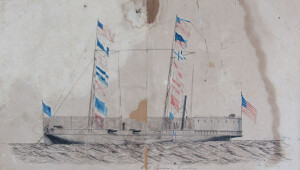 | SHORT DESCRIPTION: Pen and ink drawing highlighted with watercolor showing the USS Currituck, a US Navy gunboat in the Civil War. The ship is anchored and dressed with signal flags on both masts and there is a commissioning pennant flying on the aft mast. There is a small boat moored at the side of the ship. Netting surrounds the forward deck and there is wooden structure enclosing the stern. A funnel is mounted on the deck behind the aft mast. Section of a newspaper page is attached to the back of the mat. VESSEL INFORMATION- VESSEL NAME: SENECA (1843-1861); USS CURRITUCK (1862-1865); ARLINGTON (1865-1870) VESSEL TYPE: Wood hull, schooner rig SHIPBUILDER: William H. Brown SHIPBUILDER LOCATION: New York, New York BUILD DATE: 1843 SHIPOWNER: Dudley Buck & Company, Bucks Transportation Company DIMENSIONS: 120' x 23' x 7'6", 193 tons VESSEL HISTORY: Between 1843 and 1849 it was operated by the Bucks Transportation Company on a run between New York and Hartford with the ships Uncas and Sachem. The ship was sold to the United States Navy in 1861 for $10,000 and renamed Currituck. The Currituck was one of the escorts of the USS Monitor as she headed for Hampton Roads in March of 1862. 1862 March 4, 1862: Order of the commandant navy yard, New York, to Lieutenant Worden, U. S. Navy, commanding U.S.S. Monitor, to proceed with that vessel to Hampton Roads. NAVY YARD, NEW YORK, March 4, 1862. SIR: When the weather admits you will proceed with the Monitor under your command to Hampton Roads and on your arrival report to the senior naval officer there. I have hired the steamer James Freeborn to tow the Monitor, and have also directed the propellers Sachem and Currituck to attend on you to the mouth of the Chesapeake. If it should be necessary to retain them longer, you are authorized to do so. When you shall have no further occasion for the Freeborn, be pleased to give the captain a certificate with directions to return to New York, and immediately on his arrival report to me. Wishing you a safe and successful passage, I am, respectfully, your obedient servant, H. PAULDING, Commandant. ________________________________________ March 4, 1862: Order of the commandant navy yard, New York, to Acting Master Shankland, U. S. Navy, commanding U.S.S. Currituck, to convoy the U.S.S. Monitor to the mouth of the Chesapeake Bay. NAVY YARD, NEW YORK, March 4, 1862. SIR: You will, with the steamer Currituck under your command, proceed to sea tomorrow morning in company with the Monitor, and attend on her until you see her safely up to the mouth of the Chesapeake Bay. after doing so, continue on to Port Royal, in obedience to the orders of the Department. Respectfully, your obedient servant, H. PAULDING, Commodore. ________________________________________ March 6, 1862: Report of Lieutenant Worden, U.S. Navy, commanding U.S.S. Monitor, of the departure of that vessel from New York Harbor. U.S.S. Monitor, Off New York Harbor, March 6, 1862. SIR: By the pilot I have the honor to report that we passed the bar at 4 p.m., the U.S. steamers Currituck and Sachem and the steam tug Seth Low in company. The weather is favorable. In order to reach Hampton Roads as speedily as possible, whilst the fine weather lasts, I have been taken in tow by the tug. Respectfully, your obedient servant, John L. Worden, Lieutenant, Commanding. ________________________________________ May 4th, 1862: USS Currituck captures Confederate vessel Director. May 5th, 1862: USS Currituck captures Confederate vessel Water Witch. May 7th, 1862: USS Currituck captures Confederate vessels American Coaster and Planter in the Pamunkey River, Virginia. Acting Master William F. Shankland reported that some twenty schooners had been sunk and two gunboats burned by the Confederates above West Point. ________________________________________ May 17th, 1862: The USS Sebago and Currituck escort the troop transport Seth Low several miles down the Pamunkey River, Virginia, forcing Confederates to burn or scuttle 17 vessels to prevent capture. However, the river at this point becomes so narrow that the gunboats are obliged to run backward for several miles before turning their bows around. ________________________________________ September 5, 1862: Unnamed confederate schooner burned by the USS Currituck in Old Haven Creek. ________________________________________ December 4th, 1862: USS Currituck sent up the Rappahannock River with the Anacostia, Jacob Bell, and Coeur de Lion. ________________________________________ December 10th, 1862: Part of the navy’s Rappahannock squadron. USS Currituck under acting master T. J. Linnekin sailed up to an anchorage three miles below Port Conway. Confederate artillery ambushed him a mile below his destination at Brandywine Hill, Virginia. The ship returned fire. The ship was struck at 2:25 PM. Afterwards the wounded ship limped upstream to join the Yankee, Anacostia, Jacob Bell, and Teaser. At 3:00 the Confederates attacked the flotilla. The fighting continued for an hour and then the Confederates scored a hit on the Currituck, putting a Parrot shell through her starboard side twenty inches below the waterline. The hole was plugged and 35 minutes later the ship was hit by another Parrot shell aft of the main rigging. The round breached the fire room and exploded, wounding three men including forecastle captain John McClusky ________________________________________ Abstract log of the U. S. S. Anacostia, September 29, 1862, to April 6, 1863. December 10.—At 3 p. m. enemy opened fire on U. S. S. Currituck, coming up the river. At 3:15 the enemy opened fire upon the fleet. Responded immediately with 9-inch shell gun and 50-pound rifle. At 4:45 ceased firing, not having been struck. ________________________________________ December 11th, 1862: Sent to Washington with the bodies of Captain Samuel Simmons of the schooner Kadosh and Henry F. Smith of the Currituck. The ship was leaking badly. ________________________________________ December 16th, 1862: U.S. Steamer Currituck in the Navy Yard at Washington according to letter sent to Commodore Andrew A. Harwood, Commanding Potomac Flotilla by T. J. Linnekin, acting master comdg. ________________________________________ 1863 January 3rd, 1863: USS Currituck captures Confederate sloop Potter between the Potomac and Rappahannock Rivers. ________________________________________ January 12th, 1863: USS Currituck destroys a Confederate salt works at Dividing Creek, Virginia. ________________________________________ January 13th, 1863: USS Currituck captures Confederate schooner Hampton at Dividing Creek, Virginia. ________________________________________ January 25th, 1863: USS Currituck captures Confederate sloop Queen of the Fleet in Tapp’s Creek, Virginia. ________________________________________ May 14th, 1863: Armed boats from the USS Currituck seize the Confederate ship Ladies’ Delight off Urbanna, Virginia. ________________________________________ May 21st, 1863: The Confederate ship Emily is captured at the mouth of the Rappahannock River by the USS Currituck, Anacostia, and Satellite. ________________________________________ October 21st, 1863: USS Currituck captures Confederate steamer Three Brothers in the Rappahannock River, Virginia. ________________________________________ 1864 January 5, 1864: Still on the Rappahannock. ________________________________________ January 12, 1864: A naval squadron consisting of the USS Yankee, Currituck, Anacostia, Tulip and Jacob Bell supports Union cavalry under General Gilman Marston on an expedition between the Potomac and Rappahannock rivers, Virginia. ________________________________________ Confederate Schooner Charles Henry burned by a gig from the USS Jacob Bell and USS Currituck on February 24, 1864 Confederate schooner Gratitude Henry burned by a gig from the USS Jacob Bell and USS Currituck on February 24, 1864 ________________________________________ May 17th, 1864: Currituck grounded in Rappahannock while trying to protect boats that were dragging for torpedoes around Bowlers Rocks and the beach for cords from cavalry. Couldn’t get off until next tide. Assisted by Jacob Bell. ________________________________________ William King, Captain of the Hold, US Navy, Civil War, Killed in Action on board USS Currituck on September 16, 1864 Ship reclassified as merchant vessel Arlington October 2, 1865. Ship burned November 23, 1870 in Mobile, Alabama with 13 lives lost. | CL30327 |
Created 2026 by Don Barker, CBMM volunteer, for the Chesapeake Shipbuilding Project. shipbuilding@sailingworkboats.es